Skip to content

Downhole cable protectors are installed to secure ESP cables, control lines, capillary tubes, and other completion components against the tubing or coupling during installation and operation. Because these protectors may experience impact, axial movement, lateral compression, vibration, and repeated contact with the casing, material selection directly influences product reliability.
Two common material routes are used for cast cable protectors:
- ASTM A216 WCB cast steel
- Ductile Iron 450-12
Cast steel has traditionally been selected for high-strength downhole protectors because of its tensile strength, elongation, and resistance to sudden fracture. However, modern ductile iron protectors have improved significantly through better nodularization, controlled chemical composition, optimized annealing, improved mold design, and stricter casting-defect control.
Koala can currently manufacture both ASTM A216 WCB cast steel cable protectors and Ductile Iron 450-12 cable protectors. This allows the material to be selected according to the well condition, required mechanical performance, product geometry, quantity, and overall project requirements.
Understanding ASTM A216 WCB Cast Steel
ASTM A216 WCB is a carbon cast steel grade widely used for pressure-containing and mechanically loaded cast components. In cable protector applications, WCB provides a continuous steel matrix without graphite nodules.
The material is normally selected when the application requires:
- High tensile strength
- High elongation
- Good resistance to sudden impact
- Greater plastic deformation before fracture
- Strong damage tolerance under localized overload
For the cast steel protector reviewed in the current factory program, the specified tensile strength is at least 71,000 psi, equivalent to approximately 490 MPa. The specified yield strength is approximately 250 MPa, while the minimum elongation is 22%.
These values provide a strong combination of strength and ductility. Under severe loading, a qualified WCB protector will normally deform before complete fracture. This behavior can be valuable during difficult running conditions where the protector may strike a coupling, casing restriction, or irregular wellbore surface.
Understanding Ductile Iron 450-12
Ductile Iron 450-12 is a nodular cast iron grade designed to combine castability, strength, and usable ductility.
The designation 450-12 generally represents:
- Minimum tensile strength: 450 MPa
- Minimum elongation: 12%
Unlike grey cast iron, ductile iron contains graphite in a spheroidal or nodular form. This graphite structure significantly reduces stress concentration compared with flake graphite. As a result, ductile iron has much better elongation, impact resistance, and fracture behavior than conventional grey cast iron.
For downhole cable protector applications, Ductile Iron 450-12 offers an effective balance of:
- Tensile strength
- Yield resistance
- Rigidity
- Vibration damping
- Castability
- Machinability
- Production efficiency
The current factory process has shown that the as-cast elongation can exceed 12%. After optimized annealing and microstructure control, elongation can reach or exceed approximately 18% in qualified production samples.
This improvement is important. It means that properly heat-treated ductile iron is no longer a brittle casting material comparable with ordinary grey iron. A well-controlled 450-12 protector can tolerate significant deformation without immediate cracking.
Mechanical Performance Comparison
The following table summarizes the main mechanical differences between ASTM A216 WCB cast steel and Ductile Iron 450-12 used for cable protector production.
| Performance Item | ASTM A216 WCB Cast Steel Protector | Ductile Iron 450-12 Protector |
| Material type | Carbon cast steel | Nodular cast iron |
| Minimum tensile strength | ≥71,000 psi / approximately 490 MPa | ≥450 MPa |
| Typical optimized tensile performance | Approximately 490 MPa or above | Frequently above 450 MPa; optimized batches may exceed 500 MPa |
| Yield strength | ≥250 MPa | Commonly approximately 300 MPa or above, subject to final material certificate |
| Minimum elongation | ≥22% | ≥12% in the specified grade |
| Optimized elongation after annealing | Normally remains within the WCB specification range | Can reach approximately 18% or above in qualified factory production |
| Typical hardness | 137–187 HB | Approximately 130–180 HB |
| Impact behavior | Higher plastic deformation and fracture tolerance | Good impact resistance after qualified nodularization and annealing |
| Rigidity | Good | Generally high |
| Vibration damping | Moderate | Better damping due to graphite nodules |
| Main failure concern | Permanent deformation, casting shrinkage, or hot cracking | Poor nodularity, internal porosity, or cracking if process control is inadequate |
The tensile strength difference between the two materials is smaller than many buyers expect. WCB cast steel has a minimum tensile strength of approximately 490 MPa, while 450-12 ductile iron has a minimum tensile strength of 450 MPa.
For many standard ESP cable protector applications, this difference does not automatically determine product suitability. Finished-product geometry, wall thickness, bolt design, hinge structure, cable groove, assembly torque, and casting quality may have an equal or greater influence on actual field performance.
How Annealing Improves Ductile Iron Protector Performance
Microstructure Control
The performance of a ductile iron protector depends heavily on graphite nodularity and matrix structure.
A qualified casting process must control:
- Magnesium treatment
- Inoculation
- Sulfur level
- Cooling rate
- Ferrite and pearlite ratio
- Shrinkage location
- Internal porosity
- Heat-treatment temperature and time
Poorly controlled ductile iron may contain irregular graphite, carbides, excessive pearlite, or internal shrinkage defects. These conditions can reduce elongation and increase crack sensitivity.
Optimized annealing converts the matrix toward a more ductile ferritic structure. This improves elongation and reduces the risk of sudden brittle fracture.
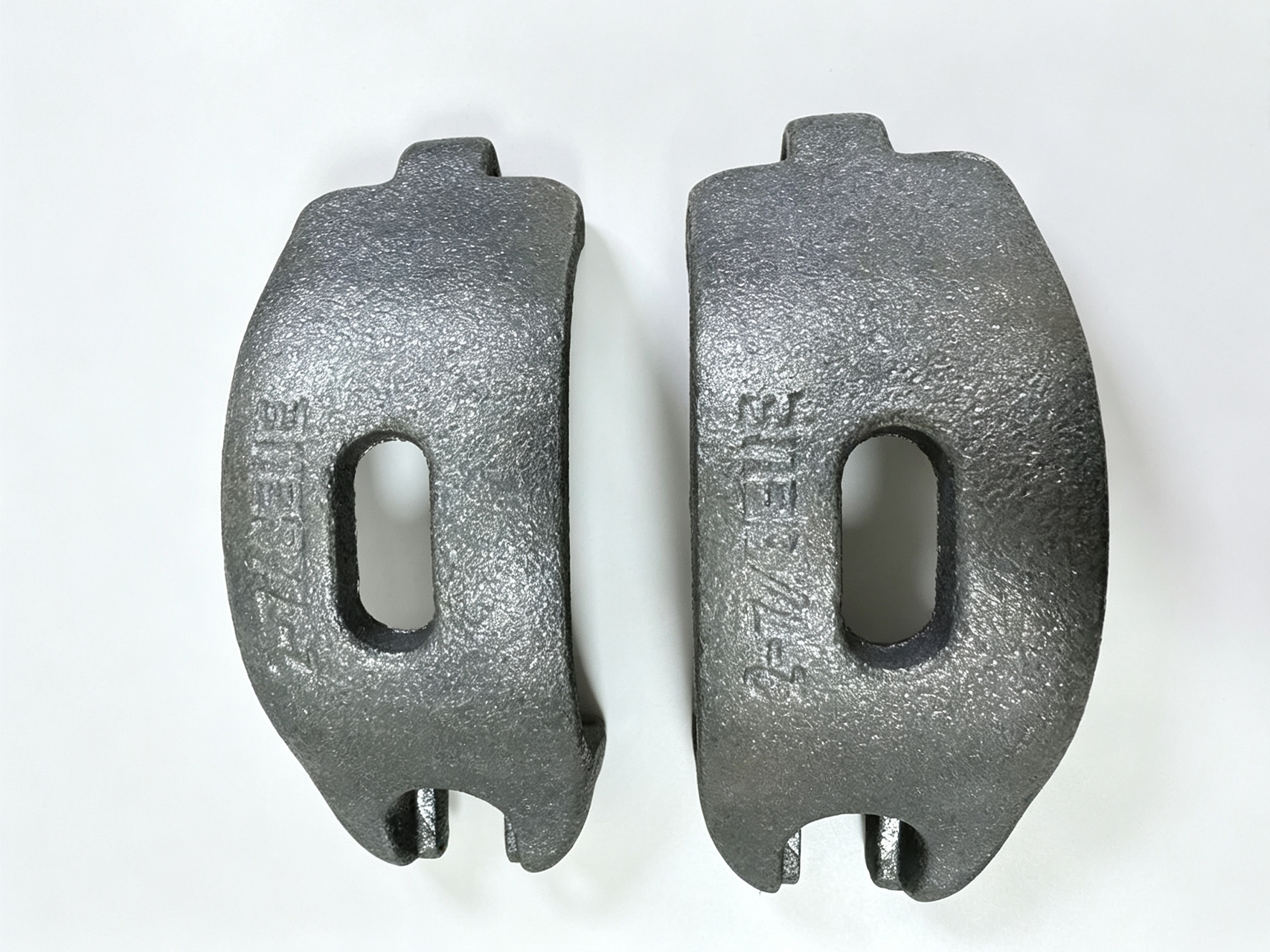
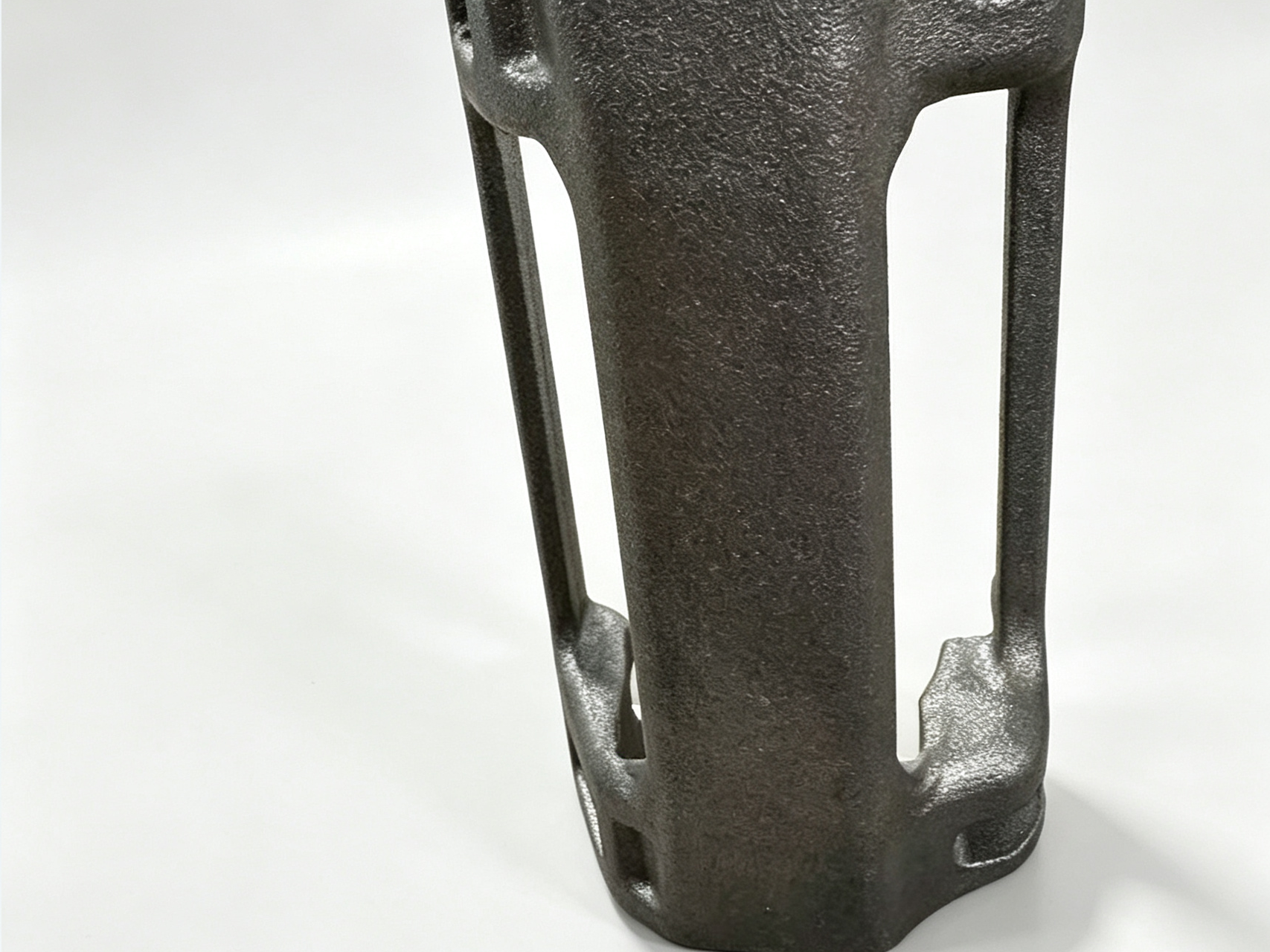
Functional Performance Close to 45-Grade Carbon Steel
After optimized annealing and casting-process control, Ductile Iron 450-12 can achieve a functional combination of strength and elongation that approaches the performance range expected from 45-grade medium-carbon steel components in this type of mechanical application.
This does not mean the two materials are metallurgically identical. Their chemical composition, graphite structure, weldability, and fatigue behavior remain different.
However, for complex cast cable protector bodies, optimized 450-12 ductile iron can provide sufficient strength, deformation tolerance, and impact resistance to meet normal downhole protection requirements.
Its practical advantage is that complicated geometries can be cast directly without extensive machining from solid steel.
Casting and Manufacturing Process Comparison
ASTM A216 WCB Cast Steel Process
Cast steel protectors are commonly manufactured through investment casting or lost-wax casting.
A typical process includes:
- Wax pattern production
- Ceramic shell preparation
- Wax removal
- Steel melting and pouring
- Shell removal and casting cleaning
- Normalizing
- Shot blasting
- Machining
- Coating
- Bolt installation and final assembly
Investment casting provides good surface finish and dimensional accuracy. It is suitable for detailed protector profiles, narrow cable grooves, and complex coupling contours.
However, steel has a higher pouring temperature and greater solidification shrinkage. The casting process must therefore control hot cracking, deformation, shrinkage cavities, and internal porosity.
Ductile Iron 450-12 Process
Ductile iron protectors are commonly produced through sand casting.
A typical process includes:
- Sand mold preparation
- Iron melting
- Nodularization treatment
- Inoculation
- Pouring
- Cooling and shakeout
- Annealing
- Shot blasting
- Machining
- Coating and assembly
Sand casting is suitable for medium and large cable protector bodies, including long and geometrically complex clamps.
Compared with investment-cast steel, the as-cast surface is generally rougher. However, the process is efficient for volume production and allows the protector body to be produced with fewer manufacturing stages.
Why Ductile Iron Protectors Are Gaining Market Acceptance
Ductile iron protectors have gained increasing acceptance in North American oilfield applications because their mechanical performance has improved while their manufacturing advantages remain significant.
Modern 450-12 ductile iron protectors can provide:
- Adequate tensile strength for standard downhole loading
- Improved elongation after annealing
- Good resistance to bending and local deformation
- Strong dimensional rigidity
- Better vibration damping
- Efficient casting of complex shapes
- Stable high-volume production
- A clear cost advantage over comparable cast steel products
Earlier concerns about ductile iron were often related to low nodularity, incomplete heat treatment, uncontrolled microstructure, or the use of ordinary grey iron instead of qualified ductile iron.
These are manufacturing-control problems rather than unavoidable limitations of the material.
When 450-12 ductile iron is produced with controlled chemistry, qualified nodularization, complete annealing, dimensional inspection, and finished-product testing, it can provide reliable performance for ESP cable protectors and cross-coupling protectors.
Koala Cast Steel and Ductile Iron Protector Capability
Koala can provide both material solutions according to the application.
Koala ASTM A216 WCB Protector
The cast steel option is suitable for projects requiring:
- Higher elongation
- Stronger fracture tolerance
- Severe-impact capability
- Investment-cast dimensional accuracy
- Customer-specified WCB material compliance
Koala Ductile Iron 450-12 Protector
The ductile iron option is suitable for:
- Standard ESP cable protection
- Cross-coupling protector applications
- High-volume requirements
- Complex cast geometries
- Projects requiring a balance of performance and cost efficiency
- Customers seeking an alternative to traditional cast steel protectors
Koala’s ductile iron development focuses on more than simply changing the base material. The production route includes control of material composition, nodularity, annealing, machining tolerance, coating, fasteners, assembly torque, and finished-product testing.
Finished-Product Testing Is the Final Acceptance Standard
Material certificates provide important information, but they do not fully determine whether a cable protector is suitable for field use.
A protector may meet the chemical and mechanical requirements of ASTM A216 WCB or Ductile Iron 450-12 and still fail because of:
- Incorrect geometry
- Excessive casting porosity
- Weak hinge design
- Improper bolt grade
- Inadequate assembly torque
- Oversized running outside diameter
- Cable slippage
- Poor coupling fit
- Local stress concentration
Koala therefore evaluates the finished protector through a complete testing program.
Final acceptance should be based on successful completion of:
- Material verification
- Dimensional inspection
- Coupling-fit verification
- Assembly-torque testing
- Tensile and axial-slippage testing
- X-axis lateral compression testing
- Y-axis longitudinal compression testing
- Crack inspection
- Permanent-deformation inspection
- Repeated assembly and disassembly testing
The protector should be considered qualified only when the complete assembled product passes the specified test requirements.